

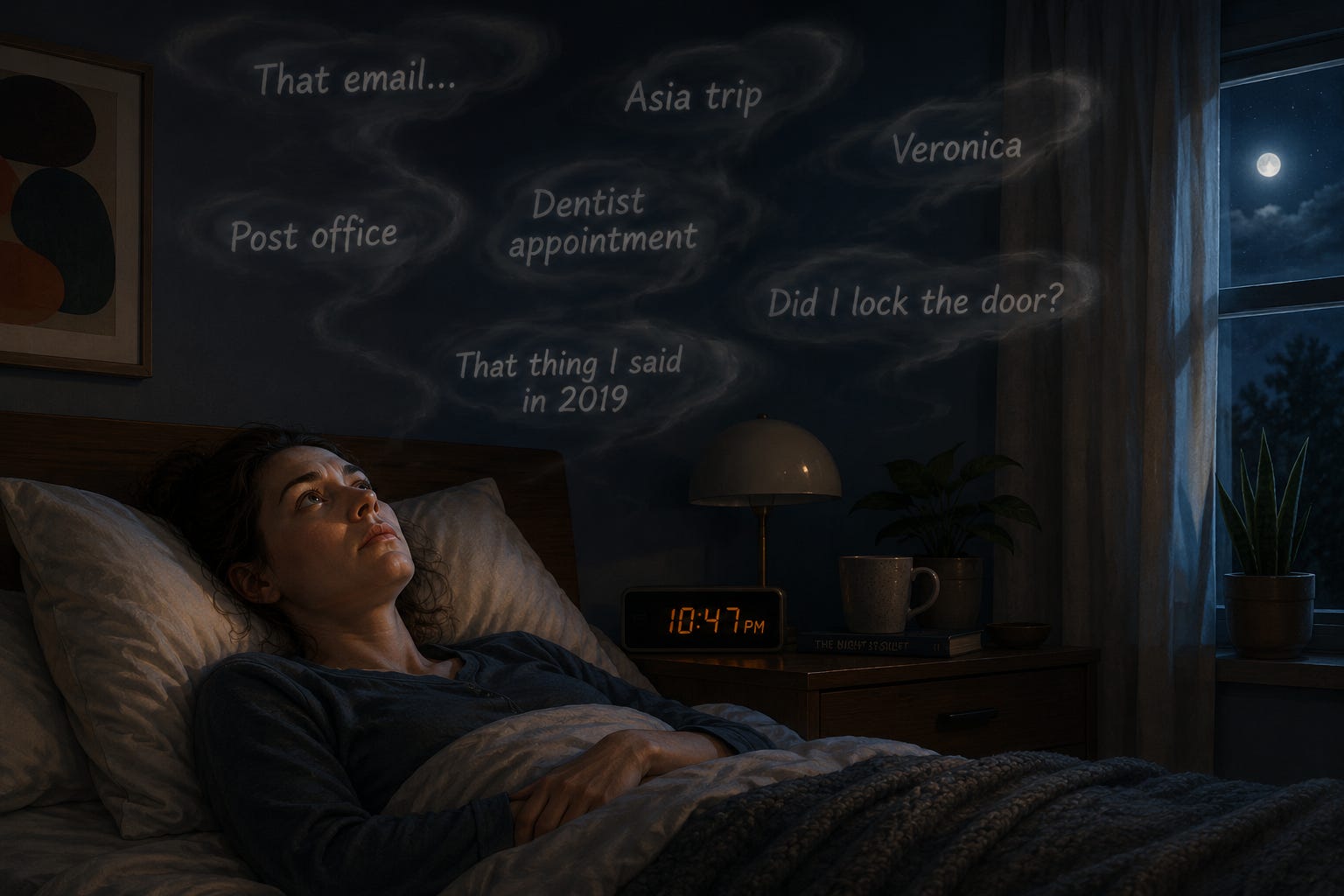
It’s Tuesday night. You’ve had a perfectly ordinary day and somehow find yourself falling asleep on the couch while watching television. So you drag yourself to bed, brush your teeth, wash your face, and settle into what can only be described as a sleep sanctuary: three pillows arranged exactly the way you like them, impossibly soft 800-thread-count sheets, and your favorite duvet.
Ahh, yes. Sleep. Finally.
And then your brain says, “Wait. Tomorrow is that meeting with the new manager. Was that at 9:00 or 10:00?”
You open one eye.
“And are we still doing the Wednesday lunch meeting if they’re there? I should email Veronica and ask.”
You glance at the clock.
10:27 PM.
“Okay, probably not. I’ll just show up at 9:00 to be safe. But if I do that, I’ll have to run to the post office afterward since they don’t open until 9:00. Although what about that consultation meeting in the afternoon? That thing always runs long. Ugh.”
You shift positions.
“Oh, right. That reminds me. I still need to answer them about the new account. I’m not sure I want to take it on. Another account means another bonus, though. Is it worth it? I mean, I do want to take that trip to Asia with my sisters. Maybe it’s worth it. I need to look at that again tomorrow. Don’t forget. Seriously. Don’t forget.”
And just like that, you’re off.
The thoughts run wild. What you forgot. What you’re worried about. What you should have said. What you need to do. What you hope happens. What you’re afraid might happen. The email you haven’t answered. The friendship you’ve been thinking about. The weird pain in your left shoulder that is probably nothing but is now somehow the most important mystery in your life.
Ten minutes ago, you were falling asleep on the couch. Now you’re conducting a full strategic review of your existence. Sleep, meanwhile, has packed its bags and left the building.
The Problem With Night Thoughts
So what the heck is going on here? Well, a few things, actually.
Throughout the day, your thoughts have competition. Emails need answering. People are talking to you. Work needs completed. You need to make dinner. There’s driving. The dog needs your attention. The kids are screaming. Something somewhere is beeping. The phone is buzzing. You’re on the treadmill.
Listen, daytime life is loud. Like, super loud sometimes. But nighttime life? Oh... it gets quiet. Really quiet. So guess what your brain does?
Yep. It gets loud.
All of those nighttime thoughts race to be heard because there are no more distractions competing for your attention.
Researchers often refer to this as nocturnal cognitive arousal —essentially, the mental activity that keeps the brain engaged when it should be winding down for sleep. Things like planning, worrying, replaying conversations, mentally rehearsing tomorrow, or trying to solve problems that absolutely do not need to be solved at 10:47 PM. Studies consistently find that this kind of pre-sleep thinking is associated with more difficulty falling asleep and poorer sleep quality.
Annoying, right? Man! But as annoying as it is, it’s actually a pretty normal brain function —sort of like your brain going through a list of unfinished business from the day. The difficulty with this is the timing.
Researchers have also found that worry about future tasks and incomplete responsibilities is especially likely to show up at bedtime. It’s part of what they refer to as bedtime worry. Much of the current literature has focused on things people ruminate about, which most often include past events or experiences. But they’ve found that future worries also play a significant role in prolonging sleep onset and increasing nocturnal cognitive arousal. The good new? A simple writing exercise in which you create a to-do list showed to help study participants fall asleep faster... more on this later.
The other problem is that nighttime thoughts have a tendency to feel more urgent than they actually are. A decision that feels manageable at 2:00 PM can suddenly feel life-altering at midnight. A problem that would barely register during lunch can become an existential crisis while staring at the ceiling fan.
Part of that is because you’re tired. Part of it is because you’re alone with the thought. And part of it is because the brain is trying to prepare, protect, and problem-solve when what you actually need is sleep. Researchers have long noted that worry and rumination create a state of mental activation that can keep the brain alert even when the body is exhausted.
Which is how you end up physically tired enough to fall asleep on the couch but mentally prepared to evaluate every decision you’ve made since middle school. Not cool!
Cool, But What Now?
The good news? Your brain isn’t broken. So, that’s a plus. Unfortunately, knowing why something happens doesn’t automatically make it stop happening.
And here’s the deal: as with most things in life, the goal isn’t to never experience it. You will never eliminate nighttime thoughts completely. You may experience them less often, have periods with few or no nighttime thoughts, or even go months, maybe years, without experiencing high levels of nocturnal cognitive arousal. But you’ll also have days, weeks, months, or even years when it’s more common.
Remember, your brain is designed to think. It solves problems, plans ahead, reflects on experiences, and occasionally decides that 11:42 PM is the perfect time to revisit something you said four months ago at a meeting that you just now realized was offensive.
I think one of the traps we often fall into with both mental and physical health is believing that everything requires immediate action and that the most extreme action is the best one. But not everything needs fixing. Sometimes it simply requires us to take notice and do a little something that helps ease the burden.
We aren’t trying to banish demons here. We’re just trying to shorten the window of nighttime thoughts from two hours to thirty minutes. From every night to half the nights of the week.
Okay, so what can we do about this? I’m glad you asked.
One of the most helpful things you can do is simply get the thought out of your head. This is where that bedtime writing study comes in. Researchers found that participants who spent a few minutes writing a to-do list before bed fell asleep faster than those who wrote about tasks they had already completed. And the more detailed, the better.
Why?
Because unfinished tasks have a tendency to keep pulling at our attention. Writing them down gives your brain a place to store them other than your working memory. In other words, your brain no longer has to keep reminding you about them every four-to-seven minutes.
Another strategy is to practice a simple question when a thought shows up: “Do I need to solve this right now?” The answer is usually no, by the way.
Your brain might desperately want to figure out next year’s vacation plans, your retirement strategy, whether you should change careers, and what your neighbor meant by that weird comment at the mailbox. But most of those things will still be there tomorrow.
And perhaps most importantly, remember that nighttime thoughts are often unreliable narrators. A problem that feels enormous at midnight frequently feels manageable at 9:00 AM. A decision that seems urgent when you’re tired may not be urgent at all.
This last one is a bit harder because anxiety can grow as we lie there unable to fall asleep and unable to stop the runaway thought train, but I’ll say it anyway. Accept that there’s a lot on your mind, stop looking at the clock, and simply lie there. Turn on some music, a sound machine, or just look out the window and take a few deep breaths.
Sometimes we don’t get enough sleep, and sometimes that happens several nights in a row. If it’s happening too often and your brain is consistently keeping you awake, it’s worth seeking professional help. But often, these periods are happening for a reason.
So... manage it in the moment, accept that it’s a rough period of sleep, and then, during your waking hours, get curious about why it might be happening right now.
Practical Tips & Tricks & A Recap
Write it down. If your brain keeps reminding you about tomorrow’s meeting, the email you need to send, or the appointment you need to schedule, get it out of your head and onto paper. Research has found that writing a simple to-do list before bed can help people fall asleep faster.
Stop doing sleep math. Looking at the clock and calculating how many hours of sleep you have left rarely helps. In fact, it often increases anxiety and frustration, making it even harder to fall asleep. Turn the clock away if you need to.
Treat thoughts like information, not assignments. Not every thought requires immediate action. A thought can simply be a reminder, an observation, or a worry. You don’t have to solve every problem the moment it enters your mind.
Save major decisions for daylight. Most nighttime thoughts feel more urgent than they actually are. If you’re debating a career change, rethinking a relationship, or planning a major purchase, chances are you’ll have more perspective after a full night’s sleep.
Give yourself time to think earlier in the day. If you’re someone who tends to worry or plan at bedtime, consider setting aside 10–15 minutes during the day to make lists, problem-solve, or think through concerns. Sometimes giving your brain a designated time to process can reduce its need to do so at midnight.
If sleep isn’t happening, get up for a bit. If you’ve been lying awake for a long time and feel yourself becoming frustrated, get out of bed and do something quiet and calming until you feel sleepy again. The goal is to keep your bed associated with sleep, not stress.
Remember that nighttime thoughts are often unreliable narrators. Things tend to feel bigger, scarier, and more urgent when we’re tired. Before giving a thought too much authority, ask yourself whether it might look different in the morning.
Aim for improvement, not perfection. You’re not trying to eliminate nighttime thoughts forever. You’re simply trying to make them a little less frequent, a little less intense, and a little less disruptive to your sleep. Sometimes success looks like shortening the spiral from two hours to thirty minutes. What a win that is!
I should probably wrap this up. Otherwise one of us is going to end up reading it at midnight and wondering whether we remembered to send that email.
Until next time…
I’m Jenn — Ordinary Therapist is where I explore the layered, often messy work of being human — things like emotional maturity, relationships, burnout, and healing — through story, reflection, and a creative lens.
If you appreciate thoughtful takes, personal insight, and the kind of honesty that makes room for both complexity and connection, you’re in the right place.
Come back, read a little, comment, subscribe, like — or just hang out. I’m glad you’re here.
Disclaimer: The content shared on this Substack is for informational purposes only and is not intended to replace professional mental health advice, diagnosis, or treatment. Always seek the advice of your physician, therapist, or other qualified mental health provider with any questions you may have regarding a medical or psychological condition.
The views expressed in the articles and newsletters are those of the author(s) and do not necessarily reflect the views of any organizations or professionals mentioned. While every effort is made to provide accurate and up-to-date information, no guarantees are made regarding the completeness or reliability of the content.
If you are experiencing a mental health crisis or need immediate assistance, please contact a mental health professional or reach out to emergency services in your area. A list of resources is available in the “Resources” post pinned to our home page.
"The good news? Your brain isn’t broken. So, that’s a plus. "
What a relief! 😊
Solid advice!
Oh wow, this has just reminded me of the little notepad I used to keep by my bed. I would write down my list, and then just the fact that it was there in case I needed to jot down a thought would stop the thoughts from coming!
It's funny how retirement from my career has meant I no longer need my notepad, and I had forgotten all about it until I read this.
FREEDOM 🤣😂
*dances around the room like George Michael